
Why LinkedIn’s new connection barriers matter for anyone building a business network
Recent changes to LinkedIn mean we’re discouraged from adding ‘new’ connections. James West, co-founder of ONLE Networking, explains LinkedIn’s connection barriers and contradictory networking guidance, and what it means for how we build a valuable business network.
LinkedIn has created a platform that makes expanding and nurturing a valuable business network easier. It has created a mechanism to understand other people and their challenges, as well as build trust and familiarity, without constantly speaking to each other.
It hasn’t and won’t replace one-to-one conversations because they are fundamental to building rapport and depth of connection. But it has become a powerful way to speed up validation and understanding of our connections by creating a kind of “hands-off” connection layer. Plus, its reach and convenience are powerful - most of us have a more geographically diverse list of contacts now thanks to LinkedIn. Yet…
“I’m LinkedIn, and I’m confused about networking”
LinkedIn has a confused approach to networking. Its own guidance suggests building a network of genuine connections, while its algorithm rewards users who stimulate and contribute to conversations. All good stuff. Yet it simultaneously offers a platform that makes it easy to add ‘connections’ while giving users very few options to screen incoming requests or encourage conversations with new connections. The result is that many LinkedIn users have a list of connections they’ve never spoken to, who have no interest in them and vice versa.
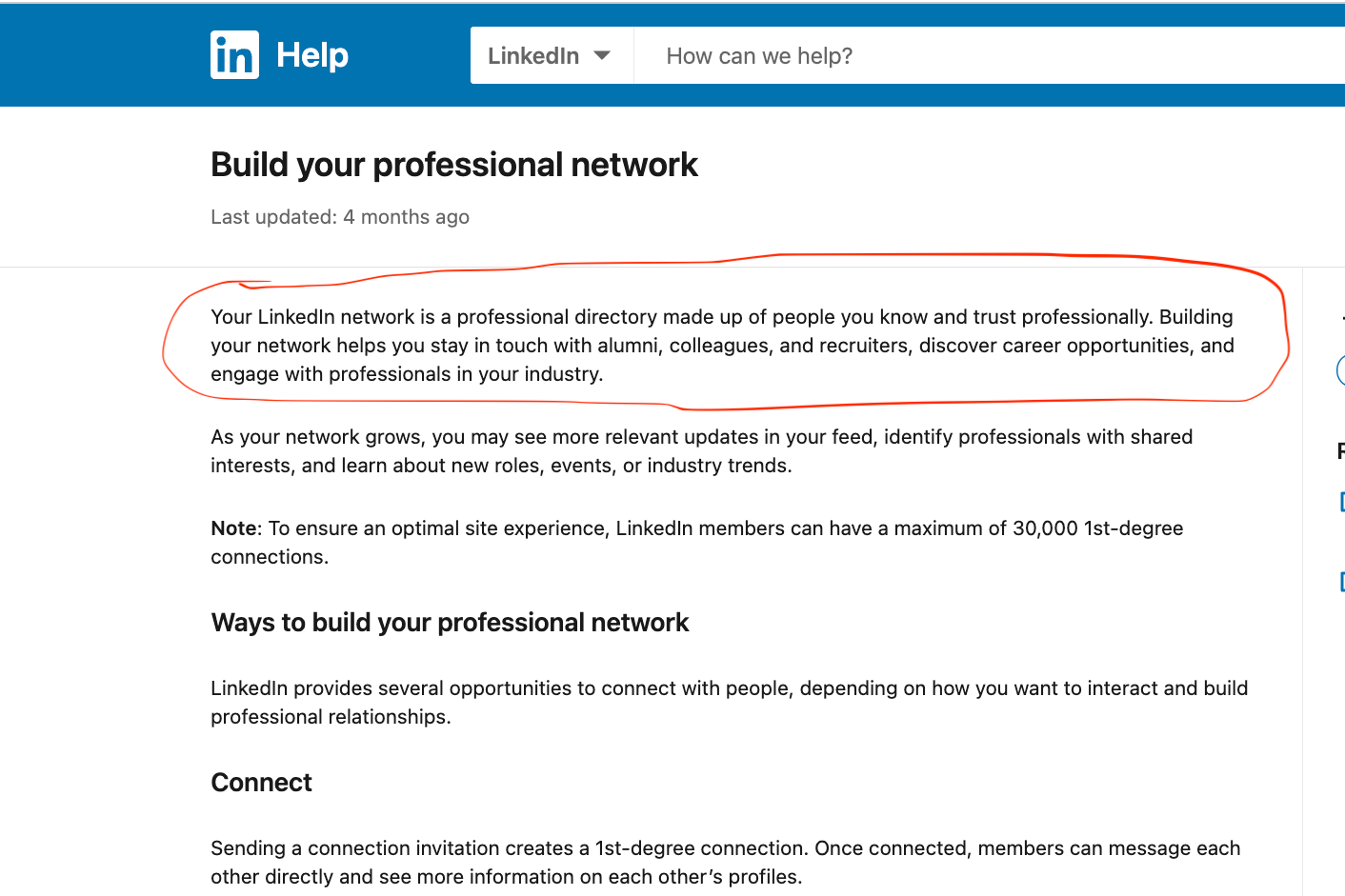
Typically confused messaging. Building a network is different to nurturing an existing one. We’re effectively being told to only do the latter on LinkedIn
As the owner and co-founder of a networking organisation, I’m highly sensitive to what my network consists of and is built upon. That’s because if I’m connected to lots of people who don’t actually know or care about me, I don’t have a network. I have a list of contacts.
This principle is especially apparent on LinkedIn, which shares your content initially with a selection of your connections and effectively shuts it down if it gets little reaction. This invariably happens if a large cross-section of your contacts have no interest in you or what you have to say. You can learn why indiscriminately accepting requests and adding connections randomly on LinkedIn ruins your engagement by reading my blog on the how and why of accepting connection requests on LinkedIn.
My way of mitigating the risk to my network’s integrity was to screen inbound connection requests before accepting them. If I didn’t recognise someone, I’d check whether we had met before and, if not, message them. If they engaged, great - I’ve made a real connection that might become fruitful. If they ignored me twice, I deleted the request.
You’ll notice I say was. That’s because LinkedIn’s new Invitations interface is removing the ability to send that pre-acceptance message. I’ve developed a workaround, which you can read in my blog about the how and why of screening LinkedIn contacts.
The new workaround is more of a faff than simply being able to message the connector before accepting the request. But I’ll put up with it. Because it’s too important. I’m not going to ruin my LinkedIn network by blindly accepting or dumping connections.
Beyond my personal niggles, there’s a far more important problem that affects all of us, and the value of LinkedIn itself. By removing the option to message people before accepting their requests, LinkedIn has pushed itself deeper into a mess of contradictory guidance around networking and connections. That contradiction is important, because it changes how LinkedIn expects us to build and maintain professional relationships.
Here’s my first finding:
LinkedIn doesn’t actually want you to build your network on its platform
The most revealing part of the new process appears when you try to accept an invitation. LinkedIn now displays a warning: “For your safety, we recommend you only connect with people you know and trust.”
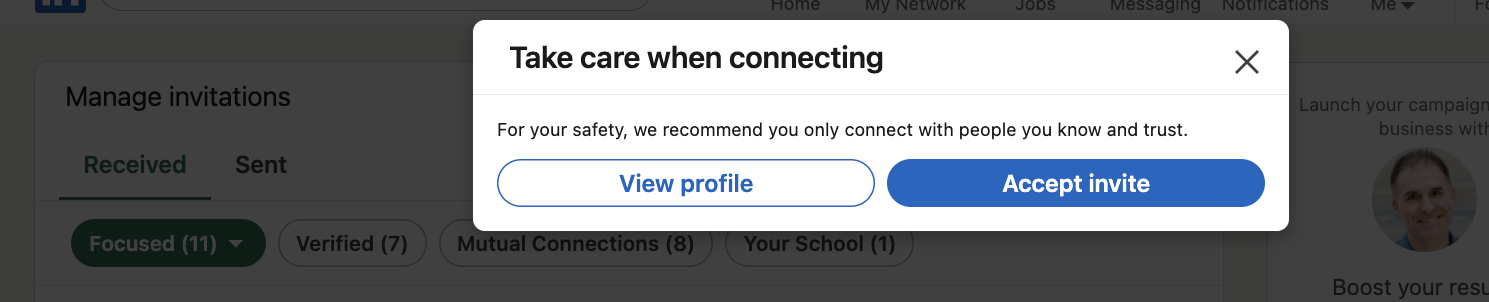
This is fair guidance. But it also means LinkedIn is telling you to network elsewhere…
That isn’t an isolated message. LinkedIn’s current guidance defines your network as a professional directory consisting of people you “know and trust professionally”. Its guidance on ‘Follow versus Connect’ says connections should be people you know and trust, and specifically gives meeting somebody at an event as an example of when connecting makes sense. Its own examples are revealing: you worked together, went to school together, know each other through your community, or recently met at an event and want to stay in touch.
In other words, LinkedIn increasingly treats a connection as something that records or extends a professional relationship, rather than necessarily being the place where that relationship begins. Yet elsewhere, LinkedIn still encourages users to grow their networks and meet new professional contacts. Perhaps there’s a reason for that contradiction:
Maybe LinkedIn knows what LinkedIn has become?
There’s probably a good reason for this. LinkedIn connection-building is a mess that’s getting worse: automated requests, outsourced appointment setters, generic pitches appearing seconds after you accept, and people pursuing enormous connection counts despite having no meaningful relationship with most of the people in them.
LinkedIn itself says it sorts invitations using authenticity signals intended to reduce spam and unwanted requests. Its current rules also warn that accounts can be restricted when invitations are reported as unwanted or spam. So perhaps LinkedIn has reached the same conclusion many of us have: more connections do not automatically create a better network.
I can only speculate why LinkedIn has removed the option. Maybe, cynically, it wants more people to pay for Premium/InMail. If so, there’s an irony in charging users to solve a problem it has created by failing to police disingenuous connections and sales spam.
Or, perhaps LinkedIn has simply accepted that it cannot reliably help users distinguish genuine new relationships from automated or indiscriminate connection-building, so rather than solve it, it has opted for the safe and highly restrictive move of steering people to only connect with those they already know.
Whatever the motivation, we’re left with the same conclusion:
LinkedIn is telling us to do the networking somewhere else
If LinkedIn says you should connect mainly with people you already know and trust, how do you meet new people? Somewhere else. Those relationships have to begin through work, introductions, communities, chance encounters and, yes, networking events.
Yes, I’m biased. I like networking events and I also think they are the best way of meeting people professionally. But to be clear: networking is a verb, not a noun. You can network when queuing for coffee, walking the dog, or at a family BBQ when you’re introduced to a fellow business owner. The act of networking isn’t restricted to networking events.

“If LinkedIn says you should connect mainly with people you already know and trust, how do you meet new people? Somewhere else. Those relationships have to begin through work, introductions, communities, chance encounters and, yes, networking events.”
James West, ONLE Networking
What networking events do provide, however, is a specific brief: to connect people. Everyone in attendance has agreed they are there to meet others and make connections. In that sense, networking events are permission-based ice-breakers. Given how difficult it has become to meet new people, combined with the fact that our default response to an unsolicited approach is often distrust, that makes them more valuable than ever.
A networking event also provides the missing relationship-building workflow: stranger → conversation → context → relationship → LinkedIn connection. You meet somebody, hear them speak, have a one-to-one conversation and discover what they do, what they’re interested in and whether you actually like talking to each other.
LinkedIn increasingly wants connections to follow trust. Which means we need other places and situations where that trust can actually begin. I favour networking events, but if you have a networking mindset, you can make new connections in many places and start the process of building trust. LinkedIn is admitting it can support that, just not provide the starting point.
There is one important caveat to this: I don’t fully agree with LinkedIn’s apparent conclusion. LinkedIn still introduces me to valuable people I would never otherwise have met, which is exactly why I’m not prepared to reject every unfamiliar connection request. Some of those unexpected contacts have become useful relationships, clients, visitors to ONLE and important parts of my wider network.
So I still think LinkedIn CAN be a place where new relationships begin. My objection is that LinkedIn is now making that harder, while simultaneously telling us that connections should already be based on trust. That contradiction is why I’ve built a workaround rather than abandoning inbound connections altogether.
LinkedIn is a networking database. Networking creates the network
In summary, LinkedIn is incredibly good at helping us maintain and extend professional relationships, but it cannot recreate the experience of actually meeting somebody. Networking as an activity will continue to be the key to building strong, valuable relationships, irrespective of the platform we use.
How to safely build your LinkedIn network without being able to send a pre-screening message
Of course, people I don’t know will continue to send me connection requests, and I don’t want to reject all of them because some of my most valuable relationships have started unexpectedly. So I’ve created a new screening process that lets me protect the quality of my LinkedIn network without losing those serendipitous connections in this blog.