
Escaping the 2D networking trap to get more clients and referrals
Why does networking work beautifully for some people, while others continue making new connections and getting nowhere? James West, co-founder of ONLE Networking, argues that we’re living in a flat plane of networking and that true success comes via pushing through the immediate boundaries of our network.
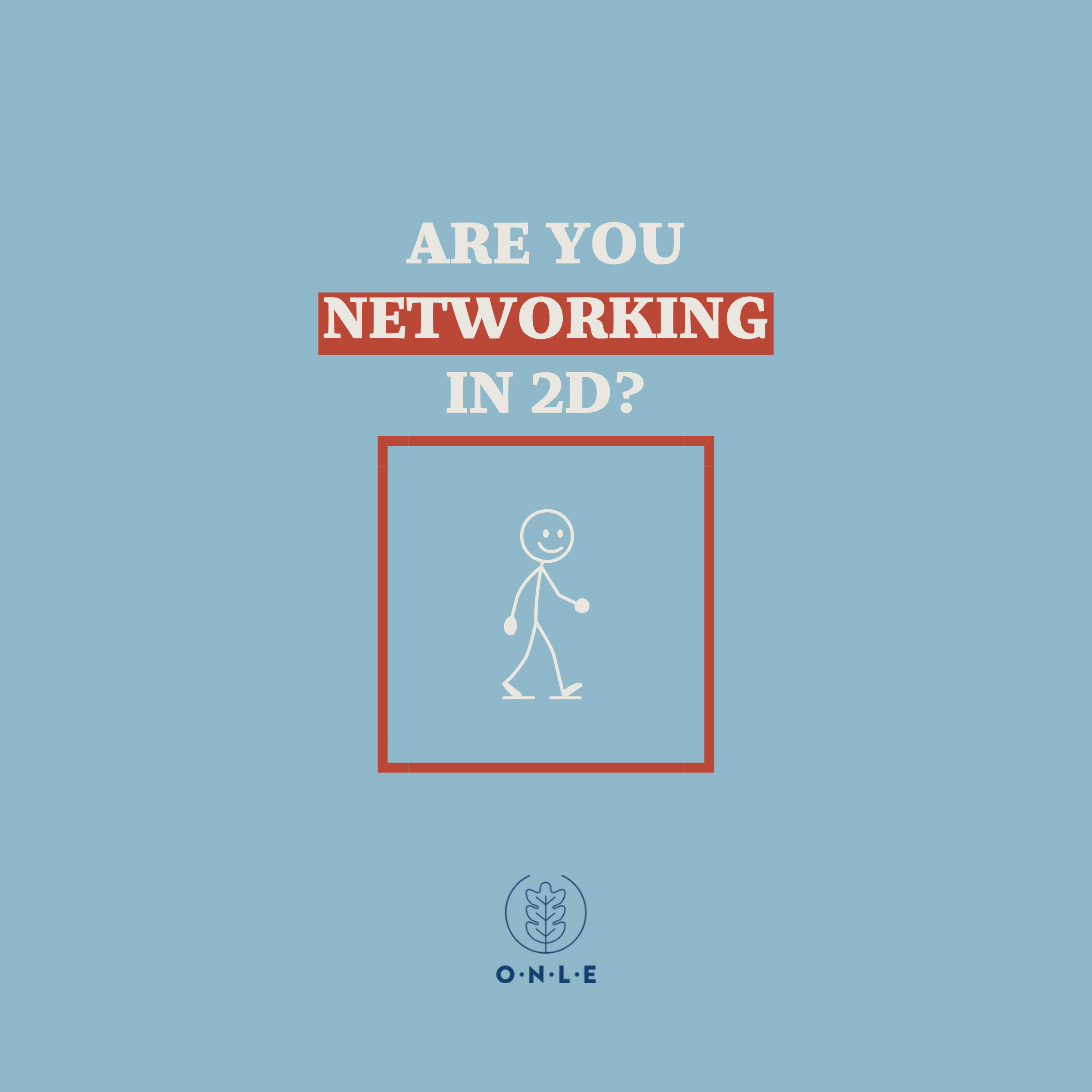
Imagine living on a flat plane. A box on a sheet of paper. You can see and move left-right. Up-down. According to your perception of the world, there’s no ‘above’ or ‘below’ the plane you’re on. You’re living in a two-dimensional world, and the notion of a THIRD dimension doesn’t baffle you because it’s outside your vocabulary and understanding of the universe.
Let’s bring that idea into networking. Most people initially have a binary, two-dimensional view of networking: “Will the person I’m talking to buy my product or service?”
Very quickly (I hope!), people evolve this thinking slightly by realising that the person they meet can lead them to a customer. And while that is true - with a caveat - this is still two-dimensional thinking. At that stage, we’re considering that person as a conduit to move us in a straight line to a customer who’s a bit further away than we can currently see. And so with this ‘expanded’ mindset, we speak to the person, tell them what we do, and tap our foot waiting for them to buy or make that magic connection to a dream customer.
And when this doesn’t work, we immediately move on to the next person and try again. And again. Depending on our resilience, at some point we try a different network. That fails. Eventually, unless we escape the two-dimensional network we’re in, we conclude that networking doesn’t work.
You’re missing an entire dimension!
So what is this third dimension of networking that we’re missing? Simply put, it’s the mind-altering scale of what a network can give us. The missing third dimension of networking - figuratively and literally - is depth.
The best way to explain this depth is through Dunbar’s Number, a concept developed by British anthropologist Robin Dunbar. His research suggests that humans can typically maintain around 150 stable social relationships. In other words, people who know our situation and care. And vice versa.
These connections are important because they represent the wider value of someone’s network. They include people we trust to varying degrees for support, guidance and advice and people who, in turn, may trust us with their problems, frustrations and challenges. Therefore, when they are looking for suppliers and experts to help with personal or professional issues, they ask their network. And this - with the same caveat I mentioned earlier which will be explained later - is where referrals and recommendations happen.
There’s an important wrinkle to the true nature of this depth. I often see people who reject someone they meet at networking because “they are not in the industry I’m targeting”. While that may be true, in networking terms, it’s largely irrelevant. Because you’re looking at the person in 2D, not their wider network.

“The caveat to networking success is this: just because someone can help you, doesn’t mean they will.”
James West, ONLE Networking
Their best friend might run the marketing department of your dream client. Their wife might be head of recruitment for THAT company. And so on. Your ‘flat’ thinking means that all those connections - NONE of which you know or are written on the forehead of the person you’ve already dismissed - are immediately beyond your reach because you are trapped in a 2D network.
Into the fourth dimension of networking
I’m at risk of over-working this analogy, but it works - so I’ll push it.
The fourth dimension is time, which has a hugely important role in successful networking. Because again, at first glance, the person you’re talking to can’t help you based on their current role or status. Yet where did they work before? Before that? Depending on their previous career, your perfect connection might be a message or email away from the person you are speaking to.
This is often true of new businesses. Yes, the owner of that start-up may currently lack buying power and the connections you’re looking for. But if you realise that many start-up entrepreneurs have recently left employment elsewhere, you may ask questions. And you may then discover they are six months removed from - and still close to - the very people working for your dream client. You just didn’t bother to find out.
And even more expansively: where will they be in the future? If you look down at someone because they are not important or well connected today, you wave goodbye to their future help when they are in a position of influence. In other words, if we ignore the fourth dimension of networking, we are stuck at a fixed point: “You’re not helpful to me now, so there’s no point getting to know you.”
That all-important networking success caveat
At several points during this blog, I’ve mentioned or alluded to a caveat to gaining customers from networking. It’s important because even when you understand and operate in four-dimensions, the caveat to networking success is this: just because someone can help you, doesn’t mean they will.
Networking is a give-and-take activity. If you’re not willing to listen and endeavour to help others, but expect them to listen and help you, you’ll be perpetually disappointed by networking.
In my experience, it’s not that complicated. It’s simply about respect. If you treat everyone you meet as a prospect ready to be immediately discarded if the conversation doesn’t yield a result, you’ll gain very little from networking. Instead, give people your time and attention - irrespective of their industry, experience or any perceived value you’ve assigned them. This is how to build a network that will help you, now and in the future.
How to start being a 4D networker
Next time you meet someone through networking, don’t immediately ask yourself, “Can this person help me?” Instead, be curious. Who are they? What have they done before? Who do they know? Where are they going? And, most importantly, how might you be able to help them? It is the combination of flipping your mindset and agenda towards interest and intent to help that builds a network of people who are interested in helping you.
If you’d like more practical guidance on how to do this successfully, especially online, get our on-demand webinar, How to Network Online. It steps you through how I built my businesses through networking using this approach, helps you see the enormity of the opportunity networking offers and how to access it.