Most business owners want more customers, more sales and a successful, growing business. But have you considered the price you might pay for that success? Online business coach Karen Davies asks whether we should be careful what we wish for, and how to ensure we remain in control of the businesses we build.
During ONLE Central, our monthly education and discussion session, online business coach Karen Davies challenged members to consider what would happen if their business doubled overnight.
For business owners who sell their time and expertise, twice as many clients could mean twice the income. But it might also mean twice the hours, additional staff, missed weekends or turning away work because there's simply no time to deliver it.
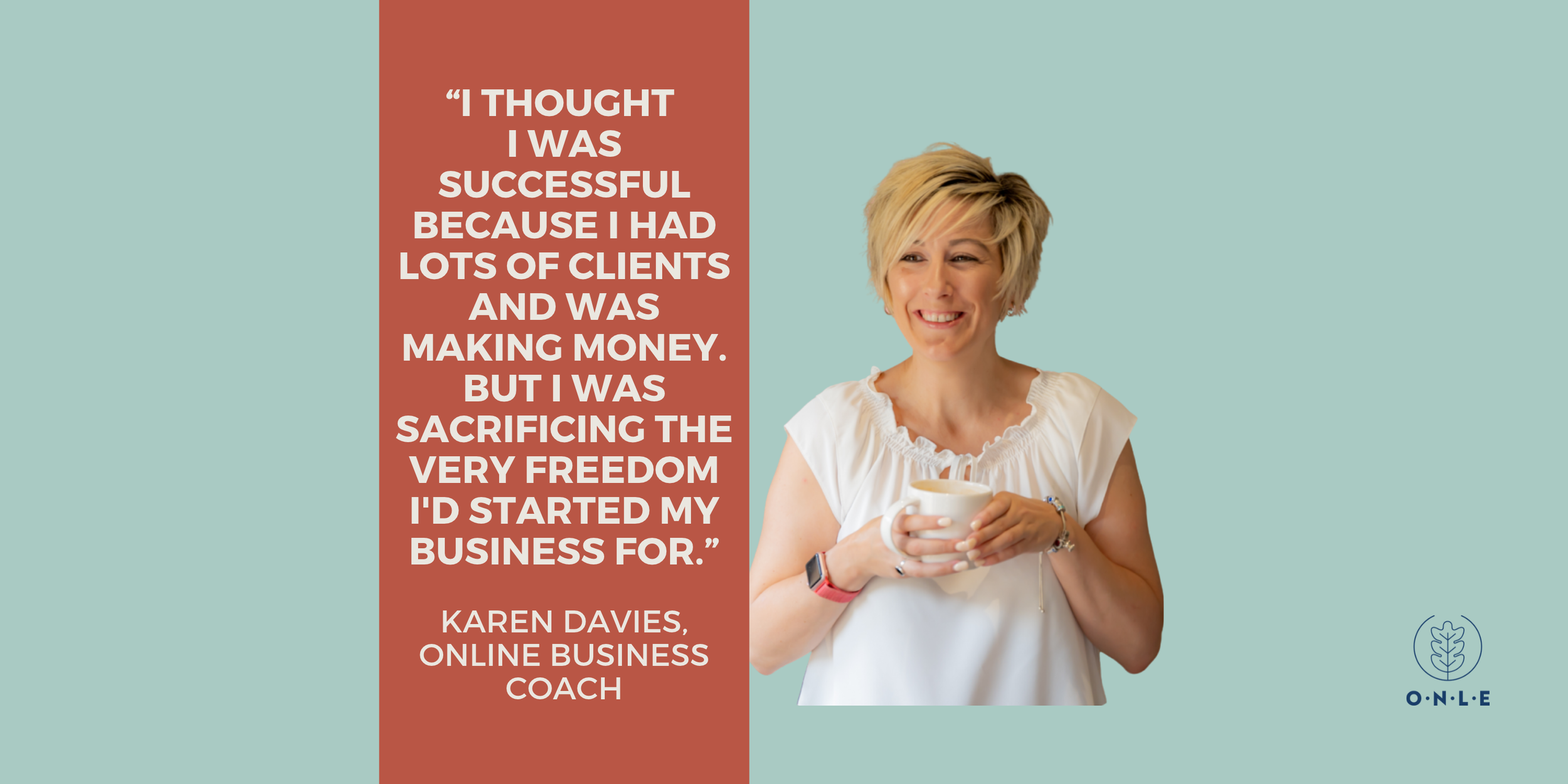
"There's a big difference between building a successful business and building a business that ultimately supports the life that you want to live."
- Karen Davies, online business coach
"Would it require you to double your hours and give more of you? Would you need to hire somebody or outsource your work? Or would you have to sacrifice weekends in order to get it done?"
Karen believes we can become so focused on attracting new business that we forget to question whether we're equipped to handle it, or even whether getting bigger is what we actually want.
Are we chasing more work than we can handle?
For many small businesses, marketing takes up an inordinate amount of headspace and chews up valuable time. The pressure to increase our visibility, generate more leads and keep filling the pipeline is omnipresent. But are we placing too much emphasis on generating demand without considering whether we can meet it? After all, most businesses have a practical limit to how many customers they can serve, especially when their owners are responsible for delivering most of the work.
Consider a consultant who can comfortably manage eight clients but currently has six. They might be investing considerable time and money in marketing, despite having capacity for only two more customers. If five new clients arrived tomorrow, they'd have to make some difficult decisions about which opportunities to accept and how to accommodate the additional work.
This can create a familiar cycle. When we're busy delivering projects, marketing takes a back seat because there simply aren't enough hours in the day. Then, when those projects finish, we're suddenly scrambling to find new customers.
Karen's point isn't that we should stop marketing or turn away opportunities. Rather, we need to consider whether increasing demand is the best way to achieve our ambitions, especially if we're already working at capacity.
What does growth actually mean?
Karen understands the problem from personal experience. She previously ran a successful branding and web studio, attracting plenty of clients and generating a healthy income. Yet as the business grew, she found herself working longer hours and sacrificing the flexibility that had encouraged her to become self-employed.
"I started my business to pick the kids up, to be there at the end of their school day," she explained.
As her client list expanded, however, she increasingly found herself missing those moments. When lockdown arrived, her projects and income were affected, and she was already exhausted. She began questioning whether she wanted to continue running the business at all.
Looking back, Karen realised she'd been measuring success by how much work she had, without considering whether that work was helping her live the life she'd originally wanted.
She explored a different approach to generating income, developing digital products and online courses that customers could purchase without requiring her to be involved in every sale.
These products initially generated modest amounts, but they demonstrated that her income didn't always have to depend on the hours she worked. More recently, she described enjoying a family holiday in New York while her business continued making sales.
For Karen, that freedom is a much more meaningful measure of success than simply having a full diary.
Could changing how you earn be more valuable than trying to earn more?
Karen encourages business owners to reconsider how they generate income and whether their business model supports their personal ambitions. Her preferred approach is to package knowledge and expertise into products that can be sold repeatedly, allowing a business to generate income without the owner having to personally deliver every product or service.
Of course, digital products won't suit every business. Other ways to create capacity might include outsourcing administrative work, automating repetitive processes, improving how services are delivered or bringing additional people into the business.
It's also worth considering whether more customers are necessary at all. Improving profitability, reviewing pricing or concentrating on more valuable work could help a business achieve its financial goals without increasing the owner's workload.
None of these changes is necessarily straightforward, and Karen acknowledges that developing alternative income streams takes time. But her experience highlights the importance of deciding what we want from our businesses before pursuing growth for its own sake.
After all, if doubling your business meant doubling your workload, would you really consider that success? Perhaps the more useful question is whether you're building a business that gives you the freedom, income and lifestyle you set out to achieve in the first place.
What is ONLE Central?
This article is based on Karen Davies' member spotlight at ONLE Central – one of nine monthly all-member events included in our membership.
These optional member events are available alongside our regional networking groups, giving members from across the UK, Ireland and the United States more opportunities to meet, learn from and build relationships with each other.
Not an ONLE member yet? You can visit one of our regional meetings for just £5 using the code ONLEHELLO. Click the button to find a meeting that suits your schedule and join other business owners in the conversation.